Symphony No.8, Op.131
Work details | Recordings | Programme notes | Reviews | Related news
Work details
-
2014
-
26 minutes
-
3 Flutes (III = piccolo), 3 oboes (III = cor anglais), 3 clarinets (III = bass clarinet), 3 bassoons, (III = contra bassoon), 4 horns in F, 3 trumpets in C, 3 trombones, tuba, timpani, percussion (2 players: glockenspiel, vibraphone, triangle, tambourine, large suspended cymbal, bass drum), harp, celesta, strings
-
- Allegro
- Adagio
- Allegretto con spirito
-
Also versions of fourth movement as Three to Tango, Op.51a.
-
Commissioned by BBC Radio 3.
-
17 April 2015
-
Bridgewater Hall, Manchester
-
BBC Philharmonic Orchestra
-
HK Gruber
Recordings
-
Symphony No.8 – Part of the 21st Century Symphony Project
track 3: Allegro -
track 2: Adagio
Programme notes
My Ninth Symphony began in a modest way in December 2015 when I wrote a little carol for the solstice for my wife Jenifer, with words about the coming of spring. One day in January I was playing it on the piano and, beginning to improvise, I thought “I can turn this into something bigger, and why not a symphony?” I felt a little uneasy about using such a simple tune for a symphony, particularly with this number, but I was reminded of Nielsen’s Sixth, whose almost naïve opening leads to much more serious events. So my tune, now in C major instead of its original G, began to explore more complex and darker regions as my sonata-form first movement progressed. The coda gently brings back the carol, which moves unexpectedly into A flat major and a solo violin melody at the end.
I began the ‘Variations for Strings’ with two preliminary ideas. The first was that my chosen chorale theme should appear at the end rather than the beginning. Since the words of the chorale are a prayer for a peaceful night, it seemed appropriate that the chorale should be the culmination of the piece, while the variations might be seen as reflecting the activities of the day. The second idea was that the string writing should be as diverse as possible, and that all 24 players should on occasion be used as soloists.
Mozart’s Sinfonia Concertante for violin and viola is one of my favourite works of his. I have always loved the special relationship between the two soloists: rather than rivalry, there is a sense of coming together in friendship. I have tried to express the same harmonious qualities in my own Double Concerto.
David Matthews
Reviews
Hilary Finch, The Times, 20 April 2015
David Matthews didn't think he'd be writing any more symphonies. But the BBC Philharmonic liked his 2013 Proms piece, A Vision of the Sea, so much that they twisted his arm for an Eighth Symphony. Not that it took much twisting. There's a tang of sea here, too: at the end of the heady dances of the finale, there's a tingling downward glissando on the violins, inspired by vapour trails in the sky over Deal, in Kent. This is where a friend of Matthews lived and died - and that remembered sorrow darkens the symphony's slow movement, giving weight and depth to its otherwise euphonious sweet song. The entire symphony, with its confident, upbeat opening, its striding rhythms, its lush lyricism and its effortless yet highly accomplished invention, sounds as though it was a joy to write - and with the intention of giving great delight to its players and listeners.
Richard Whitehouse, Classical Source, 18 April 2015
It will come as no surprise to his admirers that David Matthews has continued with his symphonic odyssey, the Eighth Symphony (2014) both continuing on from its predecessor as well as opening up new lines of enquiry which will no doubt be pursued in due course. As with the Sixth in his cycle, Matthews has adopted a three-movement format, albeit with audibly greater expressive follow-through between them. Thus the first movement encloses its tensile and pugnacious sonata Allegro within the framework of an Andante whose initial circumspection becomes altogether more expansive and searching on its reappearance. The central Adagio is of an elegiac cast befitting its intention as a memorial (to the composer Norman Worrall), given added intensity through the fugue that gradually emerges in the strings to take the music up to a heightened recall of its main idea, and while the finale might seem intent on dispelling such solemnity, this sequence of "dance variations" takes on more ambiguous qualities as it moves toward a close of almost teasing understatement. The Eighth Symphony received an assured premiere from the BBC Philharmonic (heard to advantage in the spacious yet focussed acoustic of Bridgewater Hall) under the guidance of HK Gruber, who clearly relished the poised ambivalence of the outer movements in particular. Perhaps a degree more cumulative momentum would have been to the benefit of the finale, though such restraint was arguably in accord with music which is appreciably more than the sum of its parts - as further performances of this intriguing work will doubtless convey.
Releated news
World premiere: Symphony No.8
-
27 January 2020
-
Victoria Simmonds, mezzo-soprano
-
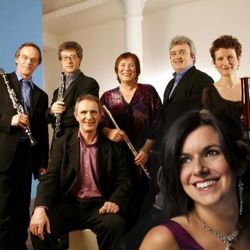
Nash Ensemble
-
The Queen’s Hall, Clerk Street, Newington, Edinburgh
Symphony No.8
-
2 April 2020, 1pm
-
Catherine Ennis, organ
-
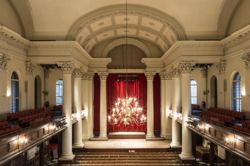
St John’s Smith Square, Westerminster, London